


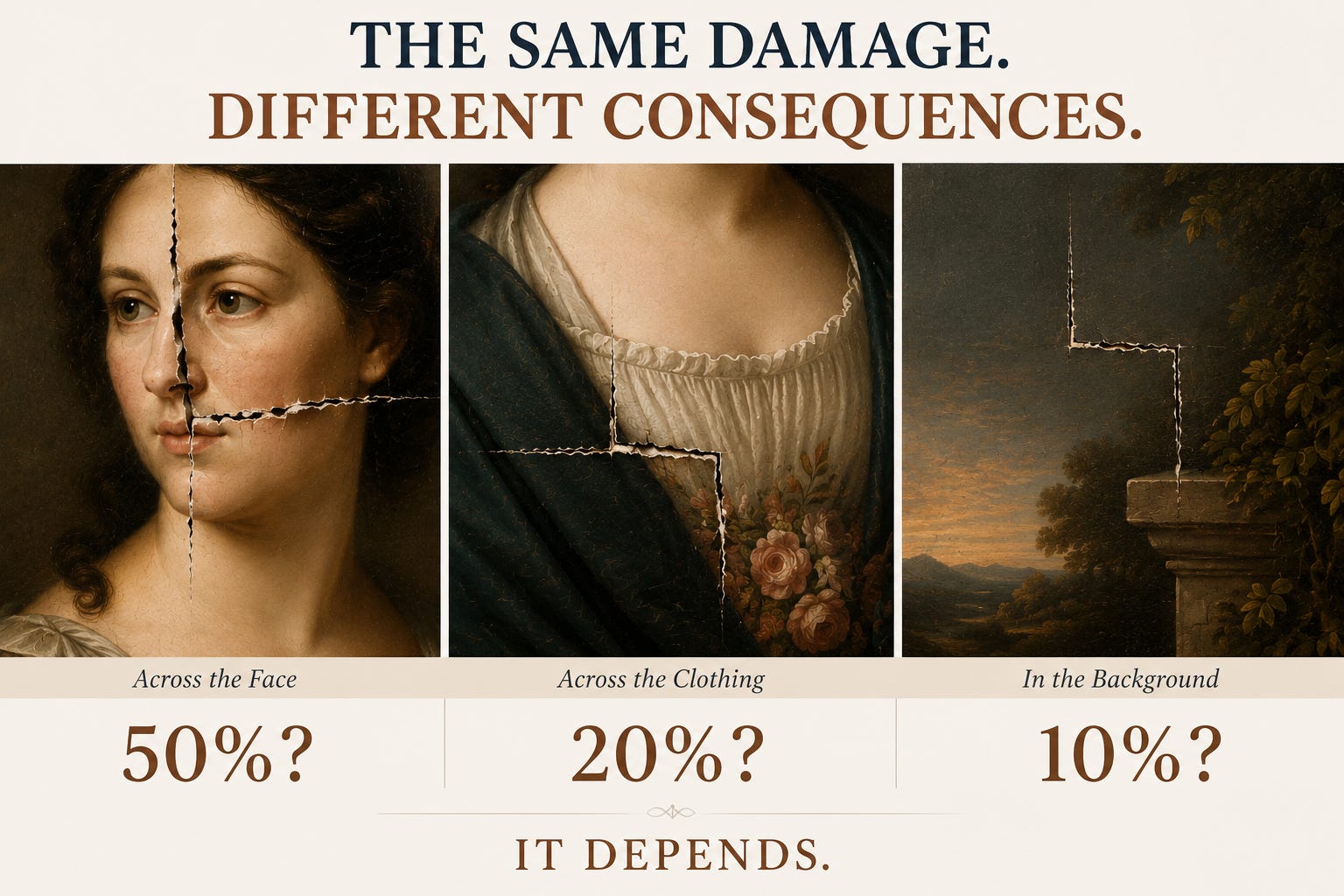
More than twenty years ago, when I was still relatively new to working as an independent appraiser, I attended an appraisers’ conference where a group of very experienced appraisers gave a presentation on condition and loss in value. I remember sitting there listening intently. I had left the auction world, was building my own appraisal practice, and this was exactly the sort of practical information I wanted from people who had been doing this much longer than I had.
At some point, they handed out a document. It was only a few pages long, but it essentially provided a guide to percentage losses in value based on different types of damage. If an antiquity had a chip, there was a suggested percentage. A repaired crack warranted another. Other types of damage had their own corresponding ranges.
I remember thinking it was brilliant.
Here it was: the answer.
Damage the object. Identify the type of damage. Apply the appropriate percentage. Calculate the loss.
Wouldn’t it be wonderful if it were actually that simple?
In fairness, guides like that can be useful. They can provide a starting point, particularly for someone learning to think about how the market reacts to different types of damage. And there are circumstances in which certain types of damage do tend to produce reasonably predictable market reactions.
The danger comes when the guideline becomes the answer.
It reminds me of what happens when someone discovers an auction result for an object that looks like something they own. “One just like mine sold for $50,000!”
Except it isn’t just like theirs.
The one that sold for $50,000 is larger. Or earlier. Or signed. Or has a better provenance. Or is a more desirable subject. Or has retained its original surface. Or perhaps it simply appeared at the right auction at the right moment with two people in the room who desperately wanted it.
Comparable sales are evidence. They aren’t automatic answers.
Condition is much the same.
Imagine an L-shaped tear in a painting. For argument’s sake, let’s say the tear is three inches long. It has been professionally treated, the canvas stabilized, and the loss sensitively inpainted.
How much value has the painting lost?
I can’t tell you.
Not yet.
Where is the tear?
If it runs through an insignificant area of background—a dark patch of sky, perhaps—the market may respond one way. Move exactly the same tear across the sitter’s face in a portrait and the reaction can be very different.
Who painted it?
A tear in a painting by a living artist who is still actively producing work exists in a very different market from a similar tear in a painting by an artist who died two hundred years ago. How rare is the work? How important is it within the artist’s oeuvre? How much undamaged material by that artist is available? How condition-sensitive are the collectors who buy that particular artist?
Then we have to consider the quality of the conservation. Is the repair visible? Was original paint lost? How much inpainting was required? Was the treatment properly documented? Is the damage structurally stable? Can the intervention be reversed?
Suddenly my tidy little percentage chart isn’t looking quite so useful.
That is the rabbit hole of loss in value.
And I happen to love it.
Loss in value is one of those areas of appraisal where you have to bring almost everything together at once: knowledge of the object, knowledge of condition, an understanding of conservation, experience with the market and, perhaps most importantly, an understanding of how buyers actually behave.
Because ultimately, that is what we are trying to measure.
Not how upsetting the damage is.
Not how much the owner wishes it had never happened.
Not even necessarily how much the conservation cost.
We are trying to determine how the marketplace reacts to the object after the damage and treatment compared with how that same marketplace would have reacted to it before.
And sometimes the answer is something people don’t particularly want to hear.
I was involved in a claim concerning a very valuable Andy Warhol screenprint that had been out on loan. When it came back, there were some marks and staining on the surface, and the work was sent to a conservator.
At the beginning, we didn’t know exactly what we were dealing with. That is important. A photograph can show you a mark, but it can’t necessarily tell you whether that mark sits on top of the surface, has penetrated it, has altered the ink or paper, or will require some kind of intervention to address it.
The conservator cleaned the work.
And the marks came off.
There was no structural damage. No inpainting was required. There wasn’t a loss that needed to be reconstructed. The offending material had essentially been superficial, and after professional cleaning the work was in better condition than it had been when the claim began.
From a valuation standpoint, my conclusion was fairly straightforward.
There was no loss in value.
That answer did not make everyone happy.
A public adjuster was involved in the claim, and there was pressure to assign some percentage of loss simply because the artwork had undergone conservation. The argument was essentially: something happened, a conservator had to become involved, therefore there must be a loss.
But those three things don’t necessarily follow one another.
If dirt is removed from an object without harming the original material, have we diminished it?
If superficial staining is successfully removed from a print and leaves no lasting evidence or alteration, what exactly is the marketplace supposed to discount?
I have even heard the attitude over the years that you should assign something—even a small percentage—because it makes the insured feel better or helps resolve the claim.
That isn’t appraisal.
An appraiser’s job isn’t to find a number that makes everyone happy. It isn’t to advocate for the insurance company, and it isn’t to advocate for the owner. It is to develop an independent opinion supported by the evidence available.
In the Warhol case, the fact that the work had been professionally cleaned did not, by itself, make it less valuable. The condition issue had been resolved without leaving the sort of permanent intervention that I believed the market would penalize.
That doesn’t mean cleaning never affects value. As I wrote at the beginning of Condition Month, I once dealt with a Henry Moore bronze that had been “cleaned” so enthusiastically that its intentionally applied patina was polished away. In that case, cleaning wasn’t benign at all. It removed part of the artist’s intended surface.
Same word.
Cleaning.
Completely different consequence.
And therefore a completely different valuation question.
This is where the role of the appraiser becomes particularly important in an insurance claim, because there can be a number of people around the table, and they do not all have the same job.
The insurance carrier has its adjuster, who may be an employee of the carrier. In other cases, an independent adjusting firm may be retained to handle the claim on the carrier’s behalf. The insured may also retain a public adjuster, depending on the circumstances and the policy. A public adjuster represents the insured and is often compensated based in some manner on the amount recovered in the claim.
Then there may be conservators, attorneys, brokers and appraisers involved as well.
Each has a different role.
And this is why independence matters so much when an appraiser is asked to determine loss in value.
Fine-art insurance policies can also contain provisions for resolving disagreements over the amount of a loss. The precise process depends on the language of the individual policy, but it may involve each side obtaining its own appraisal and, when those opinions differ materially, some form of appraisal or dispute-resolution process involving an umpire or another independent party.
The important point isn’t the mechanics of any particular insurance policy. Read your own policy for that.
The important point is that two qualified appraisers can look at the same damaged object and reach different conclusions without either one necessarily being incompetent or dishonest.
Why?
Because we’re interpreting market behavior.
One appraiser may believe collectors of a particular artist are extremely condition-sensitive and will substantially discount a repaired work. Another may find market evidence demonstrating that professionally treated examples continue to sell strongly. One may place greater weight on the location of a repair; another may find that rarity overwhelms the condition issue because collectors have so few opportunities to acquire an example at all.
That doesn’t mean anything goes.
An opinion still has to be supported.
But it does mean that loss in value is not arithmetic.
There is another complication that tends to get lost in these discussions: sometimes conservation can actually improve the marketability of an object.
Think back to last week’s discussion about restoration versus conservation. A dirty painting with discolored varnish may become considerably more visually compelling after appropriate conservation. A piece of furniture with loose elements may become safer and more usable once stabilized. A work on paper with superficial grime may present far better after careful cleaning.
That doesn’t mean conservation automatically increases monetary value either.
It means we have to look again.
What did we start with?
What happened?
What was done?
What remains original?
What changed permanently?
And how does the market respond?
Those questions sound simple written one after another. In practice, each can lead down its own rabbit hole.
After nearly three decades of looking at objects and markets, I’m actually more cautious about generalized percentages than I was when I first received that handout at the appraisers’ conference. I understand why someone created it. I understand why I found it so appealing. And I still think frameworks and guidelines can be useful starting points.
But I wouldn’t want a client, an adjuster or a young appraiser to look at a chart and conclude that a chip equals X percent, a crack equals Y percent and a tear equals Z.
Objects aren’t that cooperative.
Markets aren’t either.
A tiny loss can be devastating if it removes the signature on a painting. A far larger loss somewhere else might have surprisingly little effect. A replaced structural element on a piece of furniture may matter enormously in one collecting category and barely register in another. A professionally conserved tear may be accepted by buyers of an exceptionally rare work while the same repair could make another, readily available work much harder to sell.
The damage doesn’t exist independently of the object.
And the object doesn’t exist independently of its market.
That is why determining loss in value requires more than knowing what happened physically. You need to understand what people collect, why they collect it, what alternatives they have, what imperfections that particular market tolerates and, ultimately, how much less—if anything—a knowledgeable buyer would pay for the object because of what happened to it.
Sometimes the answer is 30 percent.
Sometimes it’s 5 percent.
Sometimes the damage can effectively kill the value.
And sometimes, as with that Warhol, the correct answer is zero.
Twenty-something years ago, I wanted the chart.
Today, I’d rather have the questions.
Because the longer I do this, the more convinced I become that the hardest part of valuing condition isn’t identifying what changed.
It’s understanding whether the market cares.
This is really evidence as to why seasoned professionals need to appraise. NOT an AI app!